
What If Market Returns Disappoint?
The default assumptions are based on long-term historical averages — but the next few decades might not cooperate. A plan that only works if markets are generous isn’t really a plan. This recipe stress-tests yours against a stingier future.
New here? Build a baseline plan first with Getting Started.
Three ways to test it — pick your depth
RetireRange gives you a ladder of tools for this question. Match the one you reach for to how serious the question is, and climb as you narrow in:
| To… | Reach for | What it gives you |
|---|---|---|
| Gut-check a small change fast — "what if stocks return 1% less?" | Option 1 — the What-If Quick Calculator | An instant, single-line estimate. Directional; no range. |
| Run a real stress test you control | Option 2 — the Assumptions tab + a full run | The whole distribution — success rate, P10, shortfall — under leaner assumptions you set. Decision-grade. |
| See how a genuinely bad start would track | Option 3 — the sequence tools | Your plan against real crashes and the timing risk that averages hide. |
Option 1 — A Fast Gut-Check (What-If Quick Calculator)
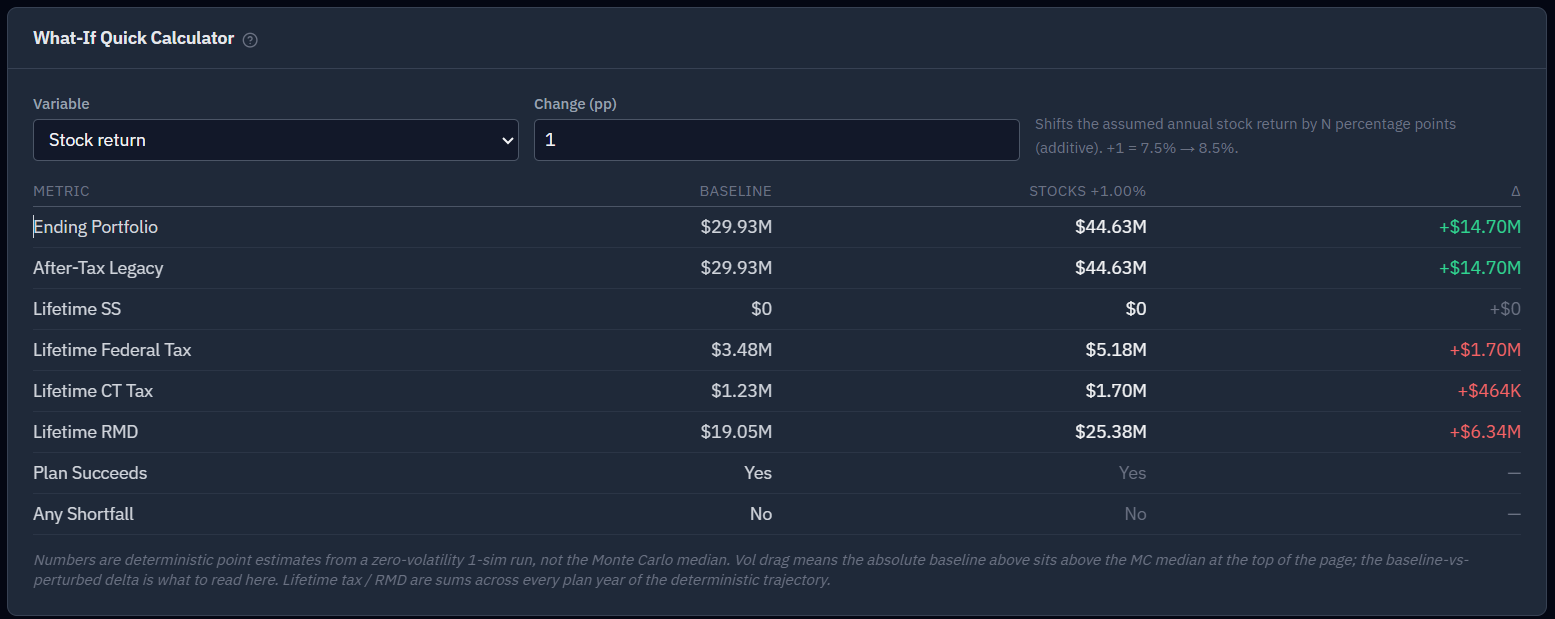
When you just want a feel for direction and rough magnitude, open the What-If Quick Calculator, pick stock return (or inflation) as the variable, and enter a change. The estimate updates instantly — no full run to set up. It’s a single deterministic path, so it answers "which way, and roughly how much," not "is my plan safe?" Use it to build intuition before you commit to a full simulation.
Option 2 — The Full Stress Test (Assumptions Tab + Monte Carlo)
This is the decision-grade version, and the one with the most control: set exactly the future you want to test, then run the whole distribution.
1. Lower the returns. On the Assumptions tab, lower your expected returns — for example, drop stocks by 1.5–2 points and bonds by 1 — and consider nudging inflation up. This models a leaner, more expensive future.
2. Save it as a scenario ("Low returns"). This recipe changes your assumptions — which live in your baseline, not in a withdrawal recipe — so save it as a full scenario, not a named strategy.
3. Run it, then compare against your baseline. If the plan holds up under pessimistic assumptions, that’s real confidence.
How to read it. Read the result on the Compare tab with Compare against baseline on: your baseline line and your leaner-future line run on the same market sequences (shared seeds) — this now covers an assumptions change, not just a strategy tweak — so the gap between the two lines is the returns change itself, not luck. You still save the change as a scenario rather than a named strategy (assumptions live in your baseline), but the comparison against baseline is a true one-thing-at-a-time, shared-seed head-to-head.
Return to your baseline when you’re done. A lower-returns test changes your baseline’s assumptions, and they persist — so every future run stays quietly more conservative until you undo it. When the stress test is done, click Load Baseline (⤺) to snap back to your saved plan.
Option 3 — Pressure-Test the Sequence, Not Just the Average
Two retirements with the same average return can end very differently depending on when the bad years hit. A crash in your first few years of retirement does damage a late one never would ("sequence-of-returns risk"). Three ways to test the timing:
- Bad-sequence overlay (on the Results tab) — drops your plan onto the worst real starting points on record (1929, 1966, 2000, 2008) so you can see how it would have tracked.
- Historical backtest — replays your strategy across every start year from 1928 to 2025, including the genuinely bad ones.
- Block bootstrap (on the Assumptions tab) — the default mode; draws returns from actual market history rather than a smooth bell curve, capturing real-world crashes and clustering. Note that lowering the expected-return inputs has no effect while you’re in this mode — switch to Stochastic (Parametric) to run a lower-return stress test.
What to look at
- Success Rate under the pessimistic assumptions — if it only looks good at default returns and collapses when you trim them, the plan is fragile.
- P10 (worst-case) outcomes and the ruin-probability chart — disappointing returns live in the lower tail, so look there, not just at the median.
- How early the trouble starts — a trajectory that sinks in the first decade and never recovers is the sequence-risk warning sign.
If a leaner future breaks the plan
- Lower your withdrawal target or switch to Guardrails so spending flexes down automatically.
- Hold a larger cash reserve and turn on downturn-aware withdrawals to avoid selling stocks at the bottom — both live on the Strategy tab as separate toggles (Downturn-Aware Withdrawals and Cash Reserve Target); switch on the cash reserve’s recovery refill so the cushion rebuilds from equity gains between drops (how it works).
- Delay Social Security to raise your guaranteed, market-proof income.
- Work a little longer or part-time to shorten the drawdown and lengthen the saving.